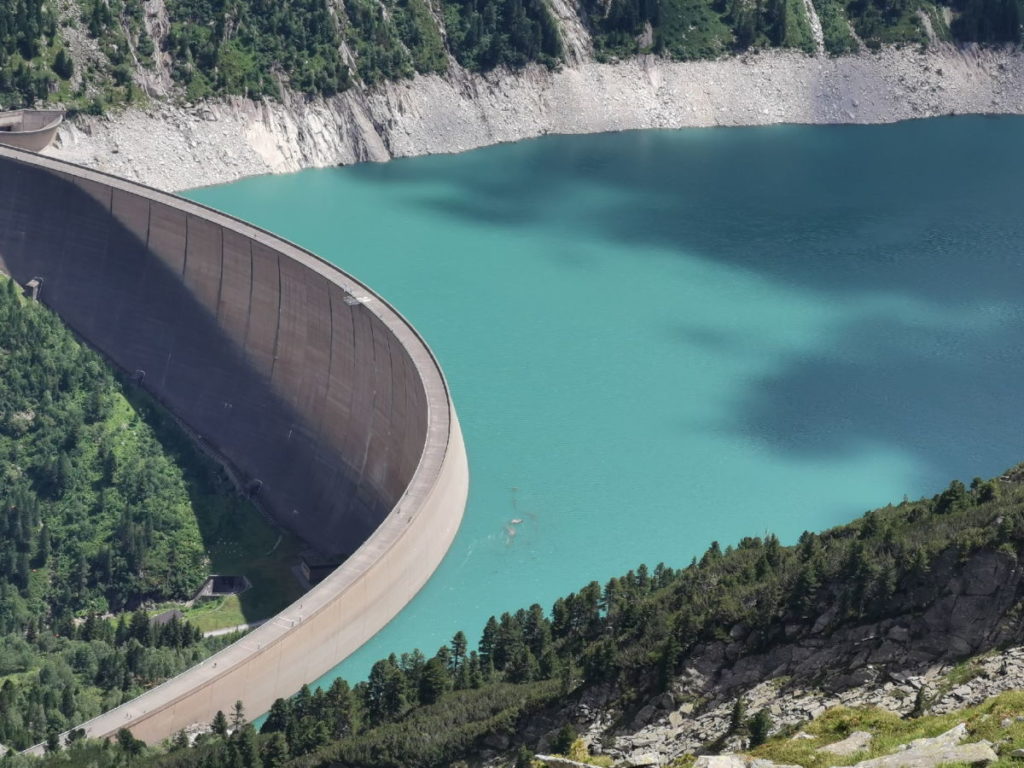
The Dam at the Schlegeis Reservoir
Darum geht es auf dieser Seite:
The Schlegeis dam wall is a true masterpiece of engineering and one of the most famous sights in the Zillertal valley. Standing 131 meters high and stretching 725 meters long, it holds back the massive waters of the Schlegeis reservoir. Construction began in 1965 and was completed in 1971. Its incredible stability comes from a double-curved design built on a solid granite foundation. The best part? You can actually step inside the dam during a guided tour.
It is a monumental engineering feat. Although the total active construction time was just three years, the work spanned from 1965 to 1971. Because of the high alpine altitude, workers could only build during the short summer months. However, the power plant actually started operating after the first few years. To make the project possible, workers first had to build the alpine road that still serves as the main access route today: the Schlegeis Alpine Road. Every single piece of material needed for the dam was hauled up this road.
Nearly one million cubic meters of concrete were used, requiring massive amounts of cement. In fact, 22,000 train wagons full of cement were delivered to Mayrhofen via the Zillertal railway and then transported up the narrow mountain road by truck. During the summer, the construction workers lived right at the Schlegeis site. Today, a small chapel stands where their accommodation used to be.
Schlegeis Dam: Quick Facts & Impressions
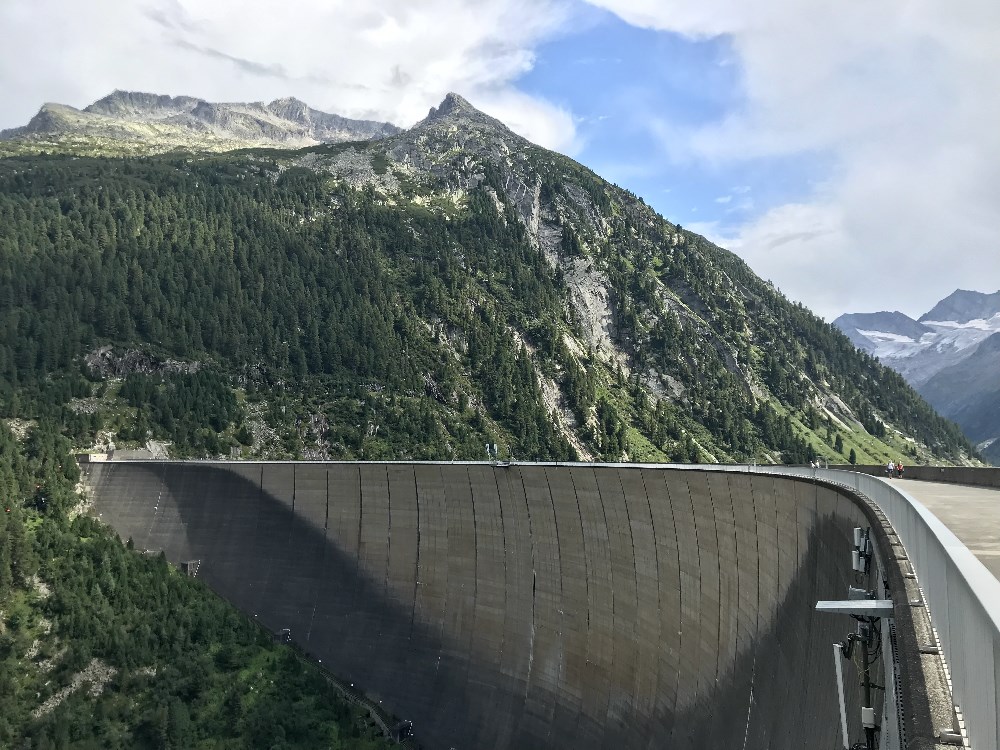
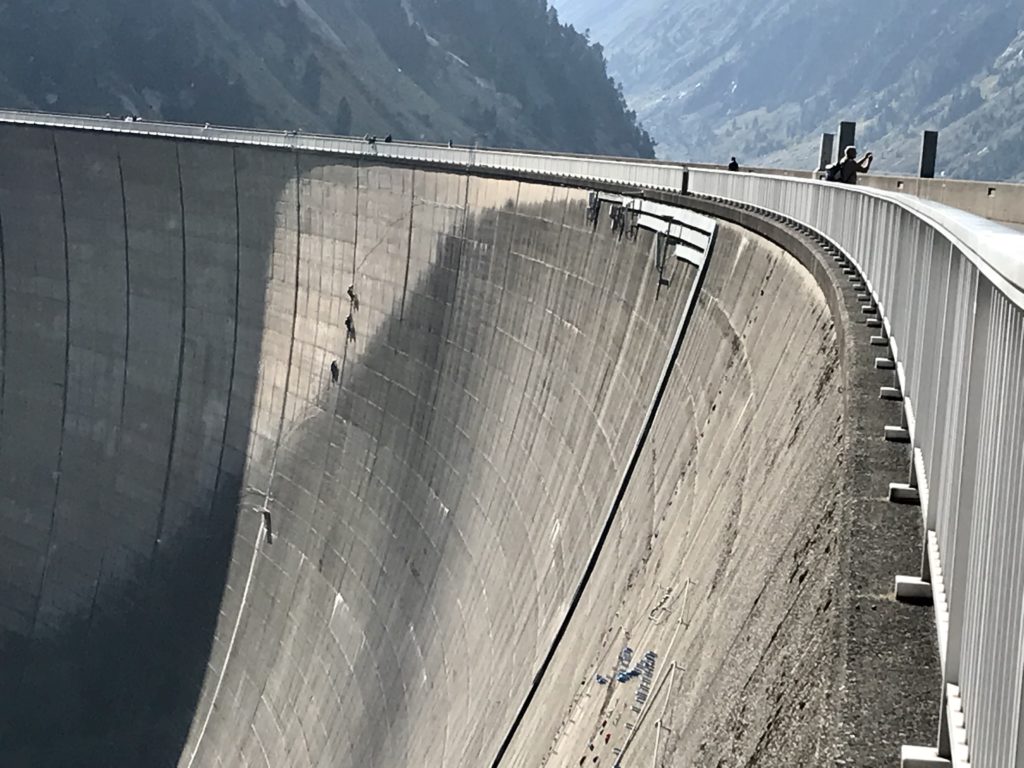
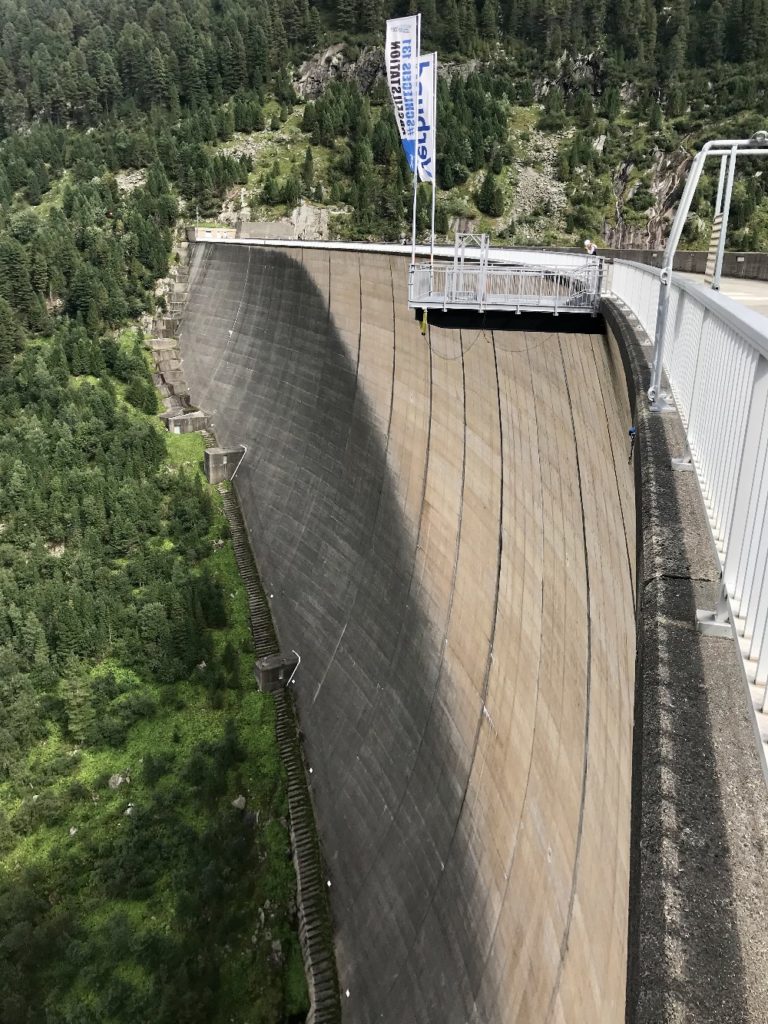
Here is how this giant came to be: The dam is 131 meters high, and its crest is 725 meters long and an impressive 9 meters wide—perfect for a leisurely stroll! At its base, the wall is an astonishing 34 meters thick. The structure consists of 44 individual concrete sections and houses 5 internal tunnels used for monitoring the dam.
As a double-curved arch-gravity dam, it holds its own weight, and its stability actually increases as the water pressure rises. This is also why the reservoir is usually kept at around 80% capacity. A fascinating detail: the dam rests on solid granite bedrock, ensuring maximum safety. Yet, when the reservoir is completely full, the immense pressure causes the crest to bend slightly—shifting about 7 centimeters downstream.
The water reaches the Schlegeis reservoir in two ways: through underground supply tunnels (some coming all the way from the Tux Glacier) and via natural streams flowing down from the surrounding mountains. The total catchment area covers 500 square kilometers. The engineering is incredibly safe: even when completely empty, the reservoir can withstand a magnitude 8 earthquake. At normal water levels, it can easily withstand a magnitude 10 earthquake on the Richter scale.
Guided Tours Inside the Schlegeis Dam
If you want to see what things look like on the inside, you can take a guided tour—and it’s highly recommended! Tours run daily during the summer season, from mid-May to the end of October. The first tour starts at 10:00 AM. Registration and the meeting point are at the dam keeper’s house (Sperrenwärterhaus). You will find it right by the first parking lot as you exit the final tunnel of the Schlegeis Alpine Road. The last tour of the day starts at 4:00 PM.
From the keeper’s house, you will walk to the dam and, after a brief introduction, head 131 steps down into the wall. There are no elevators inside the dam; even the inspectors who monitor this massive industrial structure have to walk through the shafts on foot. A total of 72 million euros was invested in building the Schlegeis dam and power plant. This tour offers a fascinating behind-the-scenes look at clean energy generation.
The Schlegeis Reservoir
Electricity is not generated directly at the dam itself, but further down the valley at the power plant, connected by an underground tunnel. Another interesting fact: the Schlegeis reservoir is linked to other reservoirs, allowing energy to be produced exactly on demand.
–> All details and more facts about the Schlegeis Reservoir
The Schlegeis Alpine Road
The Schlegeis Alpine Road was originally built to transport heavy construction materials up to the dam. Today, it is the only access road to the reservoir, offering visitors stunning views of the Zillertal valley and the surrounding peaks. The road climbs to an altitude of 1,800 meters, opening up spectacular views of the turquoise lake and the glacier landscape. The drive itself is an adventure and a great reminder of the incredible engineering it took to build the dam in the first place.
Further Links
- how to get to the Schlegeis Reservoir
- what about the opening times of the Schlegeis Reservoir
- how to explore the famos Olpererhütte Bridge
Die häufigsten Fragen
Construction on the Schlegeis dam wall began in 1965 and was completed in 1971, following a total active construction time of three years.
The Schlegeis dam stands at an impressive 131 meters high and stretches across a length of 725 meters. Its massive scale makes it a truly imposing structure.
The crest of the Schlegeis dam is a remarkable 9 meters wide. This allows visitors to enjoy a leisurely stroll across the top while taking in the views. You can even easily walk across the dam with a stroller.
Yes! There are five internal tunnels inside the Schlegeis dam, which are used for monitoring and inspecting the structure. They give engineers and technicians access to various sections to check its stability and functionality. You can get an exclusive look inside by joining a guided tour.